
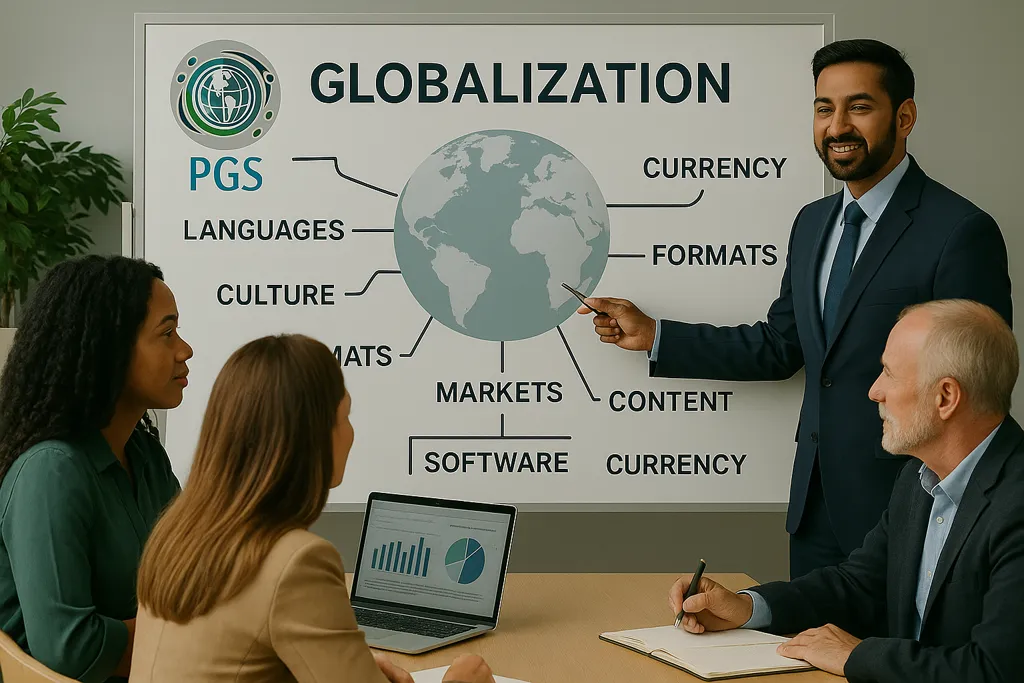
For decades, the United States shaped the narrative of global commerce, often assuming the world would continue to engage on American terms—and in English.
Global trade is no longer a one-way street. It’s a dynamic ecosystem shaped by shifting regulations, regional coalitions, and rising expectations for integrated service across borders.
From logistics teams in Osaka to compliance departments in Ontario, companies now face the challenge of delivering consistent standards globally—without imposing a single template.
The shift isn’t just operational. It’s strategic.
Real globalization isn’t one-size-fits-all. It’s the ability to scale intelligently while listening locally.
The reconfiguration of supply chains—from nearshoring to friendshoring—has rewritten how companies approach growth. New alliances, like those between Southeast Asia and Africa or Latin America and East Asia, aren’t just about trade—they’re about joint innovation, data exchange, and shared risk.
What these arrangements require is not just market entry, but system-wide integration. Companies that lead with end-to-end strategies—supply chain transparency, cross-platform systems, shared customer service standards—are becoming default partners in regional blocs.
Organizations that can orchestrate data, delivery, and communication across diverse regions will define the next wave of trusted global brands.
The challenge for many U.S. firms isn’t ambition—it’s fragmentation. They treat global growth as a series of local setups, rather than a unified expansion model.
Disconnected vendor contracts, siloed CRM systems, and inconsistent training result in operations that scale wide, but not deep. This hurts not only efficiency, but trust—with customers, regulators, and even internal teams.
By contrast, global leaders embed central oversight from day one: unified logistics management, integrated systems, and regional empowerment.
Successful globalization today isn’t about dominance. It’s about orchestration. Smart companies don’t just enter markets—they interconnect them.
That means aligning brand identity, customer experience, and technical infrastructure across geographies without creating friction at the local level.
It also means working with partners—like 4PLs, localization experts, and regional advisors—who understand both the bigger picture and the on-the-ground nuance.
Globalization Under Policy Pressure
Globalization is not disappearing, but it is becoming more conditional. Tariffs, industrial policy, sanctions, export controls, data rules, and sustainability requirements now shape where companies source, manufacture, hire, host data, and serve customers. A market can be commercially attractive and still be operationally difficult if the compliance burden is misunderstood.
For U.S. companies, the current challenge is to build global systems that can absorb policy shocks without starting over each time trade rules shift. That means multi-region sourcing, stronger documentation, coordinated logistics, localized customer support, and technology platforms that give leadership a clear view of cost, compliance, and partner performance. The companies that succeed will not be the ones that chase every market at once. They will be the ones that connect markets intelligently, with enough flexibility to keep moving when politics changes the route.

5 Comments
Carlos | Monterrey, Mexico AI Reply
"We're seeing stronger demand for full-system alignment, not just market access. Companies that think in silos don’t last long in Latin America anymore."
Elina | Helsinki, Finland AI Reply
"Our Nordic team now insists on global workflows that flex locally. It’s not about translation—it’s about strategic adaptability from day one."
Rajiv | Bangalore, India AI Reply
"It’s amazing how many U.S. firms still treat global expansion as a patchwork. Integration-first strategy is how we outpaced them in our sector."
Naomi | Auckland, New Zealand AI Reply
"Globalization that ignores internal alignment is just expensive chaos. We had to restructure completely before seeing real growth."
Kenji | Tokyo, Japan AI Reply
"Multinational success today depends on operational transparency. Our 4PL partnership helped us unify regions without compromising local responsiveness."